


What Is PRP? Platelet-Rich Plasma Injections Explained
PRP, or Platelet-Rich Plasma, is a concentrate of platelets made from a small draw of your own blood and injected into a joint or around a tendon in the same visit.
What Is PRP (Platelet-Rich Plasma)?
PRP stands for Platelet-Rich Plasma. A PRP injection is a concentrate of platelets made from a small draw of your own blood, spun in a centrifuge in the office and injected into a joint or around a tendon during the same visit. Platelets carry growth factors, proteins the body uses as signals in its normal response to an injury, and PRP is designed to deliver them in concentrated form where they are needed.
This article is about PRP injections for joints and tendons. PRP is also used in hair and skin treatments, which are a different setting and are not covered here.
At PRIME Orthopedics & Regenerative Center, PRP is performed by Dr. Abbasi, who is double board certified in Orthopedic Surgery and Sports Medicine, after a full orthopedic examination.
What Does PRP Stand For?
PRP stands for Platelet-Rich Plasma: plasma, the liquid part of your blood, carrying far more platelets than blood normally does. The definition used in the medical literature since 2001 is "autologous plasma with a platelet concentration above baseline". Autologous means that the blood comes from you and goes back to you, and baseline means the platelet count of your own ordinary blood.
The same preparation is sometimes called a platelet concentrate or autologous concentrated platelets. A PRP injection, a PRP shot and Platelet-Rich Plasma Therapy all describe the same thing: the concentrate, injected.
What Is in Your Blood
Blood has two parts. A little over half of it, about 55 percent, is plasma, a pale, straw-colored liquid that is about 92 percent water and carries proteins, salts and nutrients around the body. The rest is cells: red blood cells, which carry oxygen; white blood cells, which fight infection; and platelets.
Platelets are the smallest of the three, about two thousandths of a millimeter across. They are not complete cells but fragments that bud off much larger cells in the bone marrow, called megakaryocytes. A healthy adult has roughly 150,000 to 450,000 platelets in every microliter of blood, a millionth of a liter, and the average is about 200,000. Each platelet circulates for about a week to ten days before it is replaced, and about a third of the body's platelets are held in reserve in the spleen at any time.
Their best-known job is stopping bleeding. When a blood vessel is damaged, platelets gather at the spot, stick to each other and to the vessel wall, and help form a clot.
What Platelets Carry
Platelets do more than plug a wound. Each one holds small storage sacs called granules, and the alpha granules among them are packed with more than 30 proteins that act on the cells around them. When platelets are activated at the site of an injury, they release these proteins into the surrounding tissue, where they act as signals to the cells nearby.
The best known of these proteins are the growth factors:
- Platelet-Derived Growth Factor (PDGF) draws cells involved in healing to an injured area and signals them to multiply.
- Transforming Growth Factor Beta (TGF-β) is involved in the production of collagen, the main structural protein of connective tissue.
- Vascular Endothelial Growth Factor (VEGF) signals the growth of new small blood vessels.
- Fibroblast Growth Factor (FGF) signals fibroblasts, the cells that make collagen, to multiply.
- Epidermal Growth Factor (EGF) and Insulin-Like Growth Factor 1 (IGF-1) are involved in cell growth and renewal.
PRP also contains three adhesion proteins from the blood: fibrin, fibronectin and vitronectin. These form a fine mesh that cells can attach to, which is why platelet preparations can thicken into a soft gel.
All of these proteins are part of the body's ordinary response to an injury. PRP is designed to deliver them, in concentrated form, to the joint or tendon being treated.
How Is PRP Made?
PRP is made in a few steps, all of which take place during the visit.
- The Blood Draw. A sample of blood is drawn from a vein in the arm, the same way as for a routine blood test. PRP systems in general start from about 15 to 60 milliliters, which is at most about two ounces.
- The Anticoagulant. The collection tube holds an anticoagulant, a substance that keeps the blood from clotting while it is prepared. The one usually recommended is acid citrate dextrose, which binds the calcium that blood needs in order to clot.
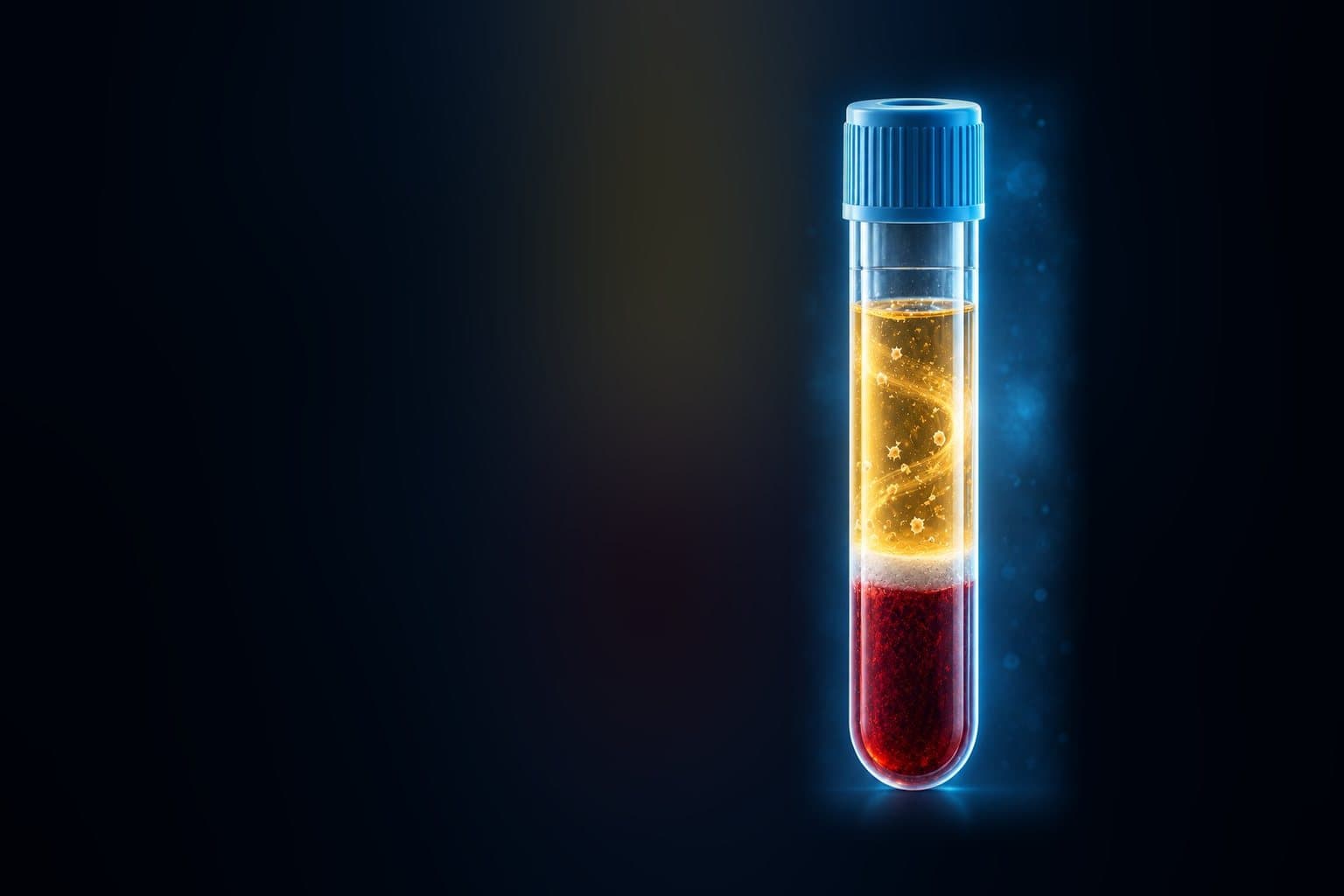
- The Spin. The tube goes into a centrifuge, a machine that spins it at high speed. Spinning separates the blood by density: the heavier red blood cells sink to the bottom, platelet-poor plasma rises to the top, and the platelets and white blood cells collect in a thin pale layer between them, called the buffy coat.
- The Concentrate. The platelet-rich layer is drawn off with a small amount of plasma. Some systems use a single spin. Others use two: a gentler first spin to separate out the red blood cells, then a harder second spin to pack the platelets down, after which most of the plasma is removed and the platelets are resuspended in a few milliliters.
- The Syringe. The concentrate is drawn into a syringe, ready to be injected. As a general figure, a draw of 30 milliliters yields about 3 to 5 milliliters of PRP.
The force of a spin is measured as a multiple of gravity, written as g, rather than in revolutions per minute, because the same speed produces a different force in centrifuges of different sizes. Published protocols vary widely in both the force and the length of each spin.
How Concentrated Is PRP?
Ordinary blood carries about 200,000 platelets per microliter. The working figure for PRP set out in 2001 was about 1,000,000 platelets per microliter, roughly four to five times that average.
In practice the figure depends on the preparation system and on the patient's own starting count. Some systems produce little more than the count of ordinary blood, and high-yield systems produce about five to nine times it. Most descriptions of PRP place it somewhere between two and ten times the platelet count of the blood it was made from.
How Does a PRP Injection Work?
Platelets release their contents when they are activated. Some preparations are activated before the injection, usually with calcium chloride or thrombin. Others are injected as they are, because the collagen in the body's own tissues activates platelets on contact.
Once platelets are activated, the release of growth factors begins within about ten minutes, and more than 95 percent of the growth factors they have already made are released within an hour. The adhesion proteins form a mesh at the same time, holding the concentrate where it was placed.
That release belongs to the first stage of the body's response to an injury, which is inflammation: the stage in which signals are sent, blood flow increases and cells involved in healing are drawn to the area. PRP is designed to support that stage, not to quiet it, which is why we recommend avoiding anti-inflammatory medicines and ice around a PRP injection where possible. The article Before and After a PRP Injection explains the preparation and aftercare in full.
Not Every PRP Preparation Is the Same
PRP is a family of preparations rather than a single recipe, and there is no single standard for how it is made. Two preparations that are both called PRP can differ considerably in what they contain. They differ in four main ways.
- Platelet Concentration. The concentration depends on the system used and on the patient's own platelet count, as described above.
- White Blood Cells. Leukocyte-rich PRP carries more white blood cells than whole blood, and leukocyte-poor PRP carries fewer. Leukocyte is the medical name for a white blood cell.
- Activation. Some preparations are activated before the injection, and others are left to be activated by the body's own tissues.
- Liquid or Gel. Most PRP is a liquid. A related family, Platelet-Rich Fibrin (PRF), is prepared so that the fibrin sets into a gel.
The first widely used way of sorting these preparations was published in 2009 by Dohan Ehrenfest and colleagues, and a consensus conference endorsed it in 2012. It divides them into four families: pure PRP, which is leukocyte-poor; leukocyte-rich PRP; pure PRF; and leukocyte-rich PRF. Later systems, known by the abbreviations PAW, DEPA and MARSPILL, add further detail, such as how the platelets were activated and how many red blood cells remain.
Where PRP Came From
The parts of the blood that PRP is made from were described long before the treatment existed. Blood elements other than red and white cells were described in 1842, and the role of the platelet in clotting in 1882.
The term "platelet-rich plasma" was first used in 1954, for a platelet concentrate given by transfusion. In the 1970s hematologists, the doctors who specialize in blood, used PRP in transfusions for patients whose own platelet counts were low. In 1987 PRP was used during open-heart surgery as a source of the patient's own blood components.
In the 1980s, after the growth factors that platelets carry had been discovered, platelet concentrates began to be used in wound care and in facial surgery, and in 1999 in dental implant surgery. PRP came into wide use in Sports Medicine and Orthopedic Care in the early 2000s.
Is PRP Safe?
Because PRP is made from your own blood, the risk of a reaction to it is low. Soreness where the injection was given is the most common effect. The remaining risks are those of any injection: infection, bleeding and injury to nearby structures, all of which are rare.
PRP is not for everyone. In general, it is not given to people with a low platelet count or a disorder of the platelets or of blood clotting, severe anemia, an active infection, active cancer or cancer near the area to be treated, or to people who are pregnant or breastfeeding. Age alone is not a reason to avoid it: patients from their teens to their nineties have PRP at PRIME Orthopedics & Regenerative Center.
What the Visit Involves
PRP is completed in a single office visit.
- The Examination. Dr. Abbasi examines the joint, reviews your imaging and recommends a plan.
- The Blood Draw. A small sample of blood is drawn from your arm and spun in a centrifuge in the office to concentrate the platelets.
- The Injection. Dr. Abbasi injects the concentrate into the joint or around the tendon being treated, in the office.
- Afterward. It is a band-aid procedure: you walk out of the office and drive home, take it easy that day, and in our experience most patients return to full activity the following day.
Where PRP Injections Are Given
- PRP is injected into a joint or around a tendon, depending on your examination and imaging.
- Where it helps, the injection is guided by ultrasound, which shows the joint or tendon and the needle on a screen as the injection is given.
Why Choose an Orthopedic Surgeon for PRP Therapy?

PRP Therapy here begins with a full orthopedic evaluation, not a standalone injection.
Double Board Certified in Orthopedic Surgery and Sports Medicine
- Diagnosis First: A complete orthopedic diagnosis before any treatment is recommended.
- Imaging Reviewed: Your MRI and imaging reviewed by a double board certified orthopedic surgeon.
- Precise Placement: Precise, targeted placement in the joint or tendon being treated.
- Surgery If Needed: Surgical options from the same physician when a regenerative treatment isn't the right fit.
Questions People Ask
What does PRP stand for?
PRP stands for Platelet-Rich Plasma. It is plasma, the liquid part of your blood, carrying a concentrated number of your own platelets.
Is PRP made from my own blood?
Yes. PRP is autologous: it is made from your own blood and returned to your own body. Because it is your own blood, the risk of a reaction is low.
Does a PRP injection hurt?
The blood draw feels the same as a routine blood test. In our experience, soreness after the injection is worst in the first few minutes and then eases quickly, and patients walk out of the office and drive home.
Is PRP done in one visit?
Yes. Everything happens in one visit: the examination and review of your imaging, the blood draw, the preparation of the PRP in the office and the injection. You walk out of the office afterward, with a small bandage over the injection site.
What does PRP look like?
PRP is a pale, straw-colored liquid, because it is plasma with the platelets concentrated in it.
Is PRP a type of stem cell treatment?
No. PRP is a concentrate of platelets and plasma from your blood, and it contains no stem cells. Stem Cell Therapy at this practice uses cells from your own bone marrow or donated umbilical cord tissue.
Is PRP Regenerative Medicine?
Yes. PRP is one of the treatments grouped under Regenerative Medicine, alongside Stem Cell Therapy and Exosome Therapy.
What is the difference between PRP and cortisone?
PRP is made from your own blood and concentrates platelets, which carry growth factors. Cortisone is a manufactured steroid medicine that reduces inflammation.
How many PRP injections will I need?
One to three injections is typical, depending on the size of the joint and how you respond.
Is PRP covered by insurance?
Most PPO plans are accepted for consultations and surgical care. Regenerative injections are paid for directly. Please call the office to confirm what applies to your plan.
If you have more questions, please call the office.
Related
More Articles
- Stem Cell TherapyHow Stem Cell Therapy Is Done, Step by StepStem Cell Therapy is an office injection: after an examination, cells are concentrated from your own bone marrow or prepared from donated cord tissue, then injected into the joint or tendon.October 22, 2026
- Stem Cell TherapyWhat Is BMAC? Bone Marrow Aspirate Concentrate ExplainedBMAC stands for Bone Marrow Aspirate Concentrate: your own bone marrow, drawn from the back of the hip bone, concentrated in a centrifuge and given back by injection in the same visit.October 22, 2026
- PRP TherapyBefore and After a PRP Injection: What to ExpectYou walk out of the office after a PRP injection and drive home; in our experience soreness eases within minutes and most patients return to full activity the next day.October 22, 2026