


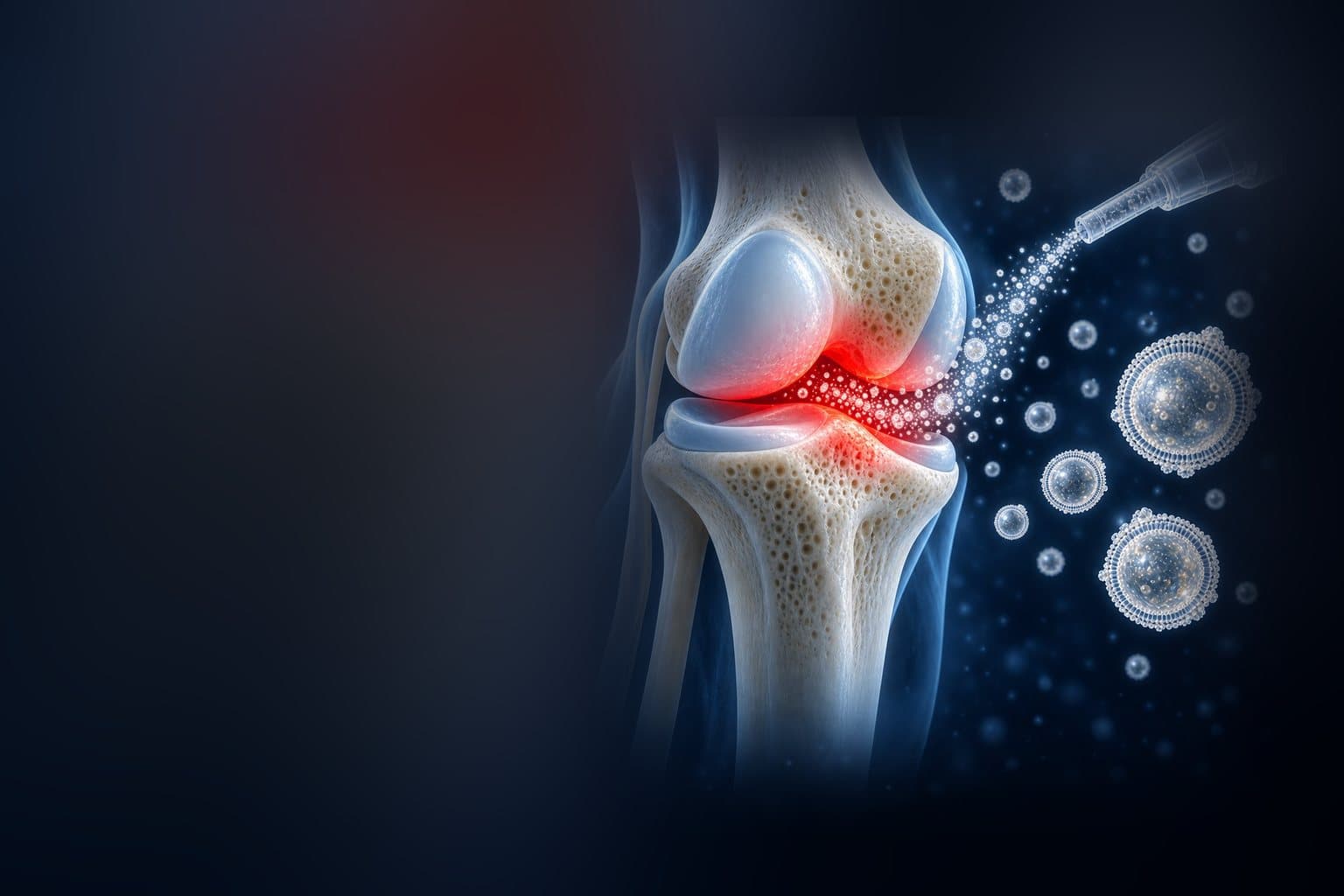
What Are Exosomes? Size, Source and How They Are Made
Exosomes are tiny membrane sacs, about 40 to 160 nanometers across, that cells release carrying proteins, lipids and RNA from the cell that made them.
What Are Exosomes?
Exosomes have moved quickly from research laboratories into clinics, and the word now appears everywhere from orthopedic offices to skincare labels, usually with little explanation of what it means. An exosome is a tiny sac, far smaller than a cell, that a living cell releases into the fluid around it. Each one is wrapped in a thin fatty membrane and carries a small load of proteins, fats and genetic material from the cell that made it.
Cells throughout the body release exosomes, and they are found in blood and other body fluids. In orthopedics, Exosome Therapy generally means an injection of a preparation of exosomes collected from donor cells cultured in a laboratory.
At PRIME Orthopedics & Regenerative Center, Exosome Therapy is performed by Dr. Abbasi, who is double board certified in Orthopedic Surgery and Sports Medicine, after a full orthopedic examination.
Exosomes and Extracellular Vesicles
Exosomes belong to a larger family of particles called extracellular vesicles, a name that simply means small sacs found outside cells. The International Society for Extracellular Vesicles, the field's scientific society, defines them as particles released from cells that are enclosed by a lipid bilayer, a double layer of fat molecules, and that cannot replicate on their own. The family has three main members: exosomes, which form inside the cell; microvesicles, which bud straight off the cell's outer surface; and apoptotic bodies, the larger fragments left behind when a cell dies in an orderly way.
Exosomes are measured in nanometers. A nanometer is a millionth of a millimeter, and a typical exosome is about 40 to 160 nanometers across, averaging around 100. Several hundred to a thousand of them laid side by side would span the width of a human hair. They are too small to be seen with an ordinary light microscope, so researchers study them with electron microscopes and with instruments that track the particles as they drift through a beam of laser light.
Strictly, a vesicle counts as an exosome only when it has been shown to form inside the cell by the route described below, which is difficult to prove for any single particle. For that reason, scientific papers often use the broader term “small extracellular vesicles”, while “exosome” remains the everyday word, including for the preparations used in clinics.
How Cells Make Exosomes
Exosomes begin inside the cell, which is what sets them apart from the other vesicles in the family. They form along the endosomal pathway, the internal system a cell uses to take in material from its surface and sort it.
- An Endosome Forms. The cell's outer membrane folds inward and pinches off, creating a small compartment inside the cell called an early endosome, which works as a sorting station.
- The Endosome Matures. As its contents are sorted, the early endosome matures into a late endosome.
- Vesicles Form Inside It. The late endosome's own membrane buds inward many times, filling the compartment with tiny vesicles. A compartment packed with these vesicles is called a multivesicular body.
- Release or Breakdown. Some multivesicular bodies travel to the lysosome, the cell's recycling compartment, where their contents are broken down. Others move to the cell surface and fuse with the outer membrane, releasing the small vesicles into the space outside the cell. Once released, those vesicles are exosomes.
A set of proteins guides each step. The best known is a group of protein complexes called ESCRT, which works alongside proteins named ALIX and TSG101 and a family of transport proteins called Rab GTPases.
What Exosomes Carry
An exosome carries a small sample of the cell that released it. Analyses of exosomes have found several kinds of cargo.
- Proteins come from both the surface and the interior of the parent cell.
- Lipids, the fat molecules of the cell's membranes, form the exosome's own outer layer.
- Metabolites and amino acids, the small molecules of the cell's chemistry, are carried inside.
- Messenger RNA (mRNA), the working copies of genes that a cell reads to make proteins, is present in many exosomes.
- MicroRNAs, very short strands of RNA that do not code for proteins, are carried along with other non-coding RNAs.
- DNA has also been found in exosomes.
Laboratories identify exosomes partly by the proteins on their surface. The most widely used markers are three proteins known as tetraspanins, CD9, CD63 and CD81, together with flotillin, TSG101 and ALIX.
A study published in 2007 changed how scientists saw this cargo. A team led by Hadi Valadi showed that exosomes released by mast cells, a type of cell found in connective tissue throughout the body, carried messenger RNA from about 1,300 genes, and that this RNA could be read and made into protein after it entered another cell. It was among the first evidence that exosomes move genetic material from one cell to another.
A Short History of Exosomes
Exosomes were first described not as messengers but as a way of discarding protein. In 1983, two research groups published their findings within about a week of each other: Clifford Harding, John Heuser and Philip Stahl in the Journal of Cell Biology, and Bin-Tao Pan and Rose Johnstone in the journal Cell. Both groups were studying reticulocytes, young red blood cells in the last stage of maturing. Both found that these cells shed their transferrin receptor, the protein a red cell uses to take up iron and no longer needs once it is mature, inside small vesicles about 50 nanometers across. Harding's group watched multivesicular bodies fuse with the cell surface to release them, a route they described as a novel mechanism.
Johnstone's group gave the vesicles the name exosomes a few years later. The word itself was not new, since it had been used in 1981 for other fragments shed from cell membranes. For roughly a decade afterward, exosomes were regarded mainly as a disposal route, the way a maturing red cell clears away proteins it no longer needs.
That view began to change in 1996, when Graça Raposo and colleagues showed that B lymphocytes, a type of white blood cell, also release exosomes, and that these carried molecules other cells could recognize. Over the following years, more cell types were shown to release them, and the 2007 RNA finding turned exosomes into a field of their own. The International Society for Extracellular Vesicles published reporting guidelines for the field in 2014, updated them in 2018, and issued its current version, known as MISEV2023.
What Is Exosome Therapy?
Exosome Therapy is the name for an injection of an exosome preparation. Such preparations are generally donor-derived and made in a laboratory by the steps described below, and in orthopedics they are given by injection into a joint or around a tendon. Exosome Therapy is often grouped with Stem Cell Therapy under the broader heading of cellular therapies, a term for treatments that use cells, or what cells release, as the injected material.
Where Therapeutic Exosomes Come From
Every therapeutic exosome preparation starts with living cells, because only living cells release exosomes. Most are made from mesenchymal stem cells, also called mesenchymal stromal cells, taken from donated tissue. Common sources are the umbilical cord, in particular Wharton's jelly, the soft gel that surrounds the cord's two arteries and one vein, the placenta and bone marrow. Because the cells come from a donor, these preparations are described as allogeneic, meaning from another person, as opposed to autologous, meaning from the patient's own body.
How Exosomes Are Isolated
Therapeutic exosome preparations are generally made in three stages, all of them in a laboratory.
- Culturing the Cells. Donor cells are multiplied in culture, kept in a nutrient liquid called a culture medium. A serum-free medium is often used, which helps keep one batch consistent with the next.
- Collecting the Medium. While they are kept in culture, the cells release exosomes into the medium around them. That medium, now called conditioned medium, is collected, and the cells themselves are removed.
- Separating the Vesicles. The exosomes are then separated from the liquid. Laboratory methods include ultracentrifugation, which spins the liquid at very high speed until the vesicles settle out; density-gradient centrifugation, which sorts particles by density; size-exclusion chromatography, which passes the liquid through a column of porous beads that sorts particles by size; filtration; and precipitation. At manufacturing scale, tangential flow filtration, which runs the liquid across a filter membrane rather than straight through it, is widely used.
How Exosomes Are Stored
Once isolated, exosomes are generally stored frozen at about −80 °C (−112 °F), the temperature of a laboratory deep freezer, and brief storage in a refrigerator at about 4 °C is also possible. Repeated thawing and refreezing reduces the number of intact vesicles and the RNA they hold and makes them clump together, so the field's reporting guidelines advise against repeated freeze-thaw cycles. Some preparations are frozen with trehalose, a sugar that protects the vesicles during freezing. Freeze-drying, which removes the water so the vesicles can be kept as a dry powder, is an alternative method that allows storage without a deep freezer.
Exosomes vs Stem Cells
Exosome Therapy and Stem Cell Therapy are often mentioned together, and the two are easy to confuse. The difference is one of kind. A stem cell is a whole living cell: it has a nucleus holding its DNA, and it can divide to make more cells. An exosome is a package that a cell has released: it has no nucleus, and it cannot divide or make copies of itself.
The two are also related. Stem cells release exosomes, as other cells do, and most therapeutic exosome preparations are made from cultures of mesenchymal stem cells. In an exosome preparation, the vesicles have been separated from the cells that released them.
Exosomes vs PRP
People comparing injection options often ask how exosomes differ from PRP. The two are different kinds of preparation, made from different starting material in different ways.
- Source. PRP is made from your own blood, drawn during the visit, while therapeutic exosome preparations are donor-derived, made from donated cells cultured in a laboratory.
- What It Is. PRP is plasma, the liquid part of blood, carrying a concentrated number of platelets, which are fragments of larger cells. An exosome preparation is a purified collection of nanometer-sized vesicles separated from the cells that released them.
- Contents. PRP consists mainly of platelets and the proteins they store, suspended in plasma. Exosomes carry proteins, lipids and RNA, including microRNA.
- Preparation. PRP is prepared in the office, in a centrifuge, during the same visit. An exosome preparation is manufactured in advance, in a laboratory.
Why Choose an Orthopedic Surgeon for Exosome Therapy?

Exosome Therapy here begins with a full orthopedic evaluation, not a standalone injection.
Double Board Certified in Orthopedic Surgery and Sports Medicine
- Diagnosis First: A complete orthopedic diagnosis before any treatment is recommended.
- Imaging Reviewed: Your MRI and imaging reviewed by a double board certified orthopedic surgeon.
- Precise Placement: Precise, targeted placement in the joint or tendon being treated.
- Surgery If Needed: Surgical options from the same physician when a regenerative treatment isn't the right fit.
Questions People Ask
What is an exosome in simple terms?
An exosome is a tiny bubble of membrane that a cell releases, carrying a small sample of the cell’s proteins, fats and genetic material. A typical exosome is about a ten-thousandth of a millimeter across.
What is Exosome Therapy?
Exosome Therapy is an injection of a preparation of exosomes, generally collected from donor cells cultured in a laboratory. In orthopedics, it is given into a joint or around a tendon.
What is an exosome shot?
In an orthopedic practice, an exosome shot means an injection of an exosome preparation, which is the same thing as Exosome Therapy. The phrase is also used for skincare products, which are applied to the skin rather than injected and are a different category of product.
Are exosomes stem cells?
No. Exosomes are vesicles released by cells, including stem cells, but they have no nucleus and cannot divide. A stem cell is a whole living cell that can divide to make more cells.
Are exosomes alive?
No. An exosome is a package of membrane and molecules rather than a cell, and it cannot reproduce or make copies of itself.
What is the difference between exosomes and PRP?
PRP is made from your own blood during the visit and is a concentrate of platelets in plasma. An exosome preparation is donor-derived, made in advance in a laboratory, and contains vesicles separated from cultured cells rather than platelets.
Where do therapeutic exosomes generally come from?
They are generally isolated from cultures of mesenchymal stem cells taken from donated tissue. Common sources are umbilical cord tissue, placental tissue and bone marrow.
How are exosomes stored?
Isolated exosomes are generally stored frozen at about −80 °C, and repeated thawing and refreezing is avoided because it reduces the number of intact vesicles. Freeze-drying is an alternative that allows storage without a deep freezer.
Who discovered exosomes?
Two research groups described them in 1983, one including Clifford Harding and Philip Stahl and the other Rose Johnstone, while studying how young red blood cells shed a protein they no longer need. Johnstone’s group named them exosomes a few years later.
Do I need a referral?
No. You may contact the office directly. If your insurance plan requires a referral, our staff will let you know.
If you have more questions, please call the office.
Related
More Articles
- Stem Cell TherapyHow Stem Cell Therapy Is Done, Step by StepStem Cell Therapy is an office injection: after an examination, cells are concentrated from your own bone marrow or prepared from donated cord tissue, then injected into the joint or tendon.October 22, 2026
- Stem Cell TherapyWhat Is BMAC? Bone Marrow Aspirate Concentrate ExplainedBMAC stands for Bone Marrow Aspirate Concentrate: your own bone marrow, drawn from the back of the hip bone, concentrated in a centrifuge and given back by injection in the same visit.October 22, 2026
- PRP TherapyBefore and After a PRP Injection: What to ExpectYou walk out of the office after a PRP injection and drive home; in our experience soreness eases within minutes and most patients return to full activity the next day.October 22, 2026