


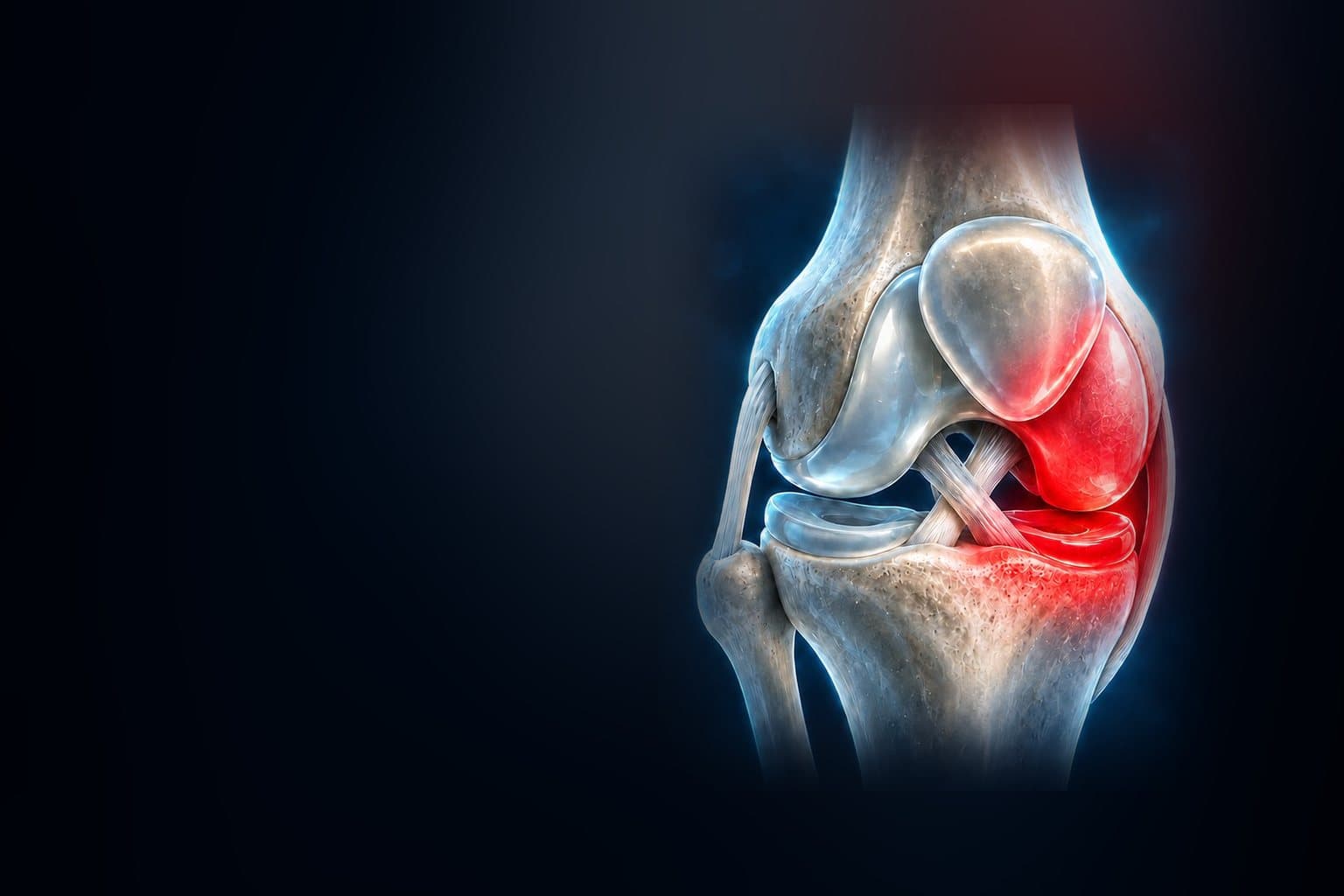
Knee Pain Going Up or Down Stairs: Common Causes
Knee pain going up or down stairs most often comes from the joint behind the kneecap, and many of its causes are treated without surgery.
Knee Pain Going Up or Down Stairs
Knee pain going up or down stairs most often comes from the joint behind the kneecap, where the kneecap glides over the end of the thigh bone. Each step bends the knee while it carries your full weight, and that presses the kneecap into its groove with about three times your body weight. A joint surface or tendon that is already irritated is often felt there first, and going down the stairs is usually where people notice it most.
The same ache often appears when squatting, kneeling or standing up after a long drive or a movie. Less often, stair pain comes from the outer side of the knee, a tendon above or below the kneecap, or a torn meniscus, and where the pain sits is the first clue to the cause.
At PRIME Orthopedics & Regenerative Center, the knee is examined by Dr. Abbasi, who is double board certified in Orthopedic Surgery and Sports Medicine, before any treatment is recommended.
How the Kneecap Works
The kneecap, or patella, is the largest of the small bones that grow inside a tendon. It sits within the tendon of the quadriceps, the large group of muscles at the front of the thigh, which continues below the kneecap as the patellar tendon and attaches to the shin bone. As the knee bends and straightens, the kneecap slides up and down in a groove at the end of the thigh bone. The two surfaces together form the patellofemoral joint.
The kneecap works like a pulley. By holding the tendon away from the center of the joint, it gives the quadriceps more leverage to straighten the knee. Its underside is lined with one of the thickest layers of cartilage in the body, up to about 5 millimeters in some adults, and that cartilage is divided into facets by a ridge that runs down the middle of the bone.
The pressure across this joint depends on how far the knee is bent while it carries weight. A 2022 review that pooled 71 studies put the force behind the kneecap at about 0.9 times body weight when walking on level ground, a little less than body weight. Going up or down stairs raised it to about three times body weight. Deep squats raise it further still, and the deeper the bend and the further the knees travel forward over the toes, the higher it goes. That is why stairs, squats, kneeling and rising from a low chair tend to bring on the same ache.
Why Knee Pain Going Down Stairs Is Often Worse
People with knee pain on the stairs usually find going down harder than going up. The measurements do not show a bigger peak force behind the kneecap on the way down; in the same review, it was about the same in both directions. The difference is in how the muscles work.
On the way up, the quadriceps shorten as they lift you onto the next step. On the way down, they lengthen while they work, acting as a brake that lowers your whole body weight one step at a time onto a bent knee. This braking work is harder to control than lifting, and each landing loads the knee while it is already bent. An irritated joint or tendon tends to complain under exactly that kind of load.
How the kneecap tracks in its groove matters too. When the thigh muscles are weak or tired, the kneecap may not follow its usual path, and the joint behind it takes more of the strain. Of the risk factors studied, weaker quadriceps muscles have the clearest evidence behind them: a 2019 review of 18 studies found quadriceps weakness linked with later Patellofemoral Pain, while age, height, body weight and the angle at which the thigh meets the shin were not shown to be risk factors.
Knee Pain on the Stairs, by Where It Hurts
Where the pain sits is one of the most useful things to notice before an examination.
- The Front of the Knee, Around or Behind the Kneecap. This is the most common place for stair pain. It usually points to the patellofemoral joint: Patellofemoral Pain, Chondromalacia Patella, or Arthritis in the joint behind the kneecap. The ache is often hard to pin to one spot, and the knee may click or grind on the stairs.
- Just Below the Kneecap. Pain over the tendon between the kneecap and the shin bone suggests Patellar Tendinitis.
- The Top of the Kneecap. Pain at the upper edge of the kneecap, where the quadriceps tendon attaches, suggests Quadriceps Tendinopathy.
- The Outside of the Knee. Pain on the outer side, especially going down the stairs or running downhill, is typical of IT Band Syndrome. Pain along the outer joint line with swelling or catching can also come from a Meniscus Tear.
- The Inner Side of the Knee. Pain along the inner joint line, with swelling, catching or locking, is a common pattern of a Meniscus Tear. Pain on the inner edge of the kneecap with clicking can come from Plica Syndrome.
- The Back of the Knee. Pain or tightness behind the knee on the stairs is less common. One cause is a Baker's Cyst, a fluid-filled swelling that usually forms when a problem inside the joint, such as Knee Arthritis or a Meniscus Tear, makes extra joint fluid; it can cause a bulge and a feeling of tightness behind the knee.
Sharp pain on the stairs, a stab rather than an ache, deserves particular attention, especially when it comes with catching or with a knee that gives way. Such symptoms can be signs of something caught or torn inside the joint, or of a kneecap that is slipping out of its groove.
Common Causes of Knee Pain on Stairs
- Patellofemoral Pain, often called runner's knee, is an ache around or behind the kneecap that is brought on by stairs, squatting, kneeling and sitting with the knees bent. It is one of the most common knee complaints: a 2018 analysis of 23 studies put its yearly prevalence at about 23 percent of the general population and about 29 percent of adolescents. It is linked with overuse, a sudden increase in activity, and weakness of the muscles that control the kneecap.
- Chondromalacia Patella is softening and roughening of the cartilage on the underside of the kneecap. It produces the same pattern of pain on the stairs and is usually grouped with Patellofemoral Pain.
- Knee Arthritis is wear of the smooth cartilage that lines the joint. The joint behind the kneecap is involved in about half of people with Knee Arthritis, and when it is, the pain often shows on the stairs and when rising from a chair.
- Patellar Tendinitis, also called jumper's knee, is irritation of the tendon that joins the kneecap to the shin bone. It is often brought on by jumping sports, by landing and slowing down, and by a sudden increase in training.
- Quadriceps Tendinopathy is irritation of the tendon that joins the thigh muscles to the top of the kneecap, and it is less common than Patellar Tendinitis. The pain usually builds gradually with activity, often without a single injury, and it is linked with repeated loading of the thigh muscles, as in jumping sports.
- IT Band Syndrome is irritation where the iliotibial band, a thick strip of connective tissue that runs from the hip down the outside of the thigh, crosses the bony outer edge of the thigh bone at the knee. It is common in runners and cyclists.
- Plica Syndrome is irritation of a plica, a fold in the lining of the knee joint left over from its development before birth. When the fold becomes inflamed or thickened, it can catch against the thigh bone, causing pain that is worse after bending, squatting or climbing stairs, along with clicking and a sense of unsteadiness on stairs and slopes.
- A Meniscus Tear is damage to one of the two C-shaped cartilage pads that cushion the knee between the thigh bone and the shin bone. It can cause swelling that builds over two or three days, catching or locking, and a sense that the knee may give way.
- Kneecap Instability means the kneecap slips partly or completely out of its groove, usually toward the outside of the knee. It is often felt as the knee buckling or giving way, sometimes on the stairs or when turning, and the knee may swell afterward.
Is It Bad to Climb Stairs with Knee Pain?
Stairs are part of normal daily life, and the knee's muscles, tendons and cartilage are built to take load. Pain that keeps returning on the stairs is a sign that something in the joint is irritated, and finding out what is the purpose of an examination.
Avoiding stairs altogether has a cost of its own. The muscles around the hip and thigh control the kneecap and absorb the load of each step, and they weaken when they are not used. In studies of people with Knee Arthritis, better stair-climbing ability went with stronger leg muscles and less pain. The aim, while the cause is being found, is to ease the load on each step rather than to stop using the stairs.
Making Stairs Easier on a Sore Knee
A few changes ease the load on the knee while you arrange to have it examined.
- Use the Handrail. Holding the rail lets your arms take part of your weight on each step.
- Lead with the Right Leg. Going up, step first with the stronger leg; going down, step first with the sorer one. Physical therapists sum it up as "up with the good, down with the bad."
- Take One Step at a Time. Bringing both feet onto each step before taking the next lets you steady yourself on every step.
- Slow Down on the Way Down. Descending slowly gives the thigh muscles time to control the bend.
- Use a Cane Where It Helps. For Knee Arthritis, a cane held in the hand opposite the sore knee takes some of the load off it, and the American College of Rheumatology's 2019 guideline strongly recommends one where it is needed.
- Avoid Deep Bends for Now. Deep squats, kneeling and very low chairs load the joint behind the kneecap the most.
When to See a Doctor for Knee Pain on Stairs
- The knee swells, especially quickly or a lot.
- The knee locks, catches or gives way.
- The pain began with a twist, a fall or a pop.
- You cannot put weight on the leg, or the knee looks out of shape.
- The knee is hot and red, or you have a fever.
- You feel numbness or tingling in the leg.
- It hurts at night or at rest.
- It has not improved after a few weeks of easing off.
If this sounds like you, let's find out why and get you taken care of. Request a Call Back.
What an Examination Involves
An orthopedic examination looks for the cause of the pain before any treatment is recommended.
- Your History. How and when the pain started, where it sits, what brings it on, and what eases it are the first questions.
- The Examination. The examination checks whether a squat or a step reproduces the pain, how the kneecap moves and tilts in its groove, how stable the ligaments are, how far the knee bends and straightens, and how strong the hip and thigh muscles are.
- X-Rays. X-rays show the alignment of the kneecap, the bones, and any narrowing of the joint from Arthritis.
- An MRI When Needed. An MRI is ordered when symptoms persist or when a tear of the meniscus, a ligament or the cartilage surface is suspected.
Treatment for Knee Pain on the Stairs
Most stair pain from the front of the knee is treated without surgery, and the plan depends on the cause. For Patellofemoral Pain, the most common cause, the 2019 clinical practice guideline of the Journal of Orthopaedic & Sports Physical Therapy places exercise for the hip and the knee together at the center of care, and it advises against kneecap braces, sleeves and straps for this kind of pain.
Without Surgery
- Physical Therapy strengthens the muscles around the hip and the thigh together, with exercises to continue at home.
- Taping the kneecap, tailored to the person, can be used alongside exercise in the short term.
- Ready-made shoe inserts can be used for up to about six weeks in people whose feet roll inward more than usual.
- Cutting back for a time on training, downhill running, deep squats and kneeling gives the joint room to settle.
- Anti-inflammatory medicines can be used for a short period.
When Surgery Is Recommended
- Surgery is recommended when an injury such as a displaced meniscus tear is not expected to settle with conservative treatment.
Your Knee Deserves a Specialist, Not a Guess

Knee Pain wears you down when nobody can tell you why. Dr. Abbasi gets to the bottom of it and stays with you for every step that follows.
Double Board Certified in Orthopedic Surgery and Sports Medicine
- You'll Know Why: A full exam and a review of your imaging.
- You'll Know Your Options: From Regenerative Medicine to surgery when it's needed.
- You'll Have One Doctor: Dr. Abbasi, at every visit, start to finish.
Questions People Ask
Why does my knee hurt going down stairs but not up?
Going down, the thigh muscles lengthen while they work, braking your body weight onto a bent knee one step at a time. That is harder to control than lifting, and a joint surface or tendon that is already irritated often makes itself felt there first.
Why does my kneecap hurt going up stairs?
Each step up bends the knee under your full weight, which presses the kneecap into its groove with about three times your body weight. Pain at the kneecap on the way up most often comes from Patellofemoral Pain, Chondromalacia Patella or Arthritis in the joint behind the kneecap.
Why does the outside of my knee hurt going down stairs?
Pain on the outer side of the knee that comes on going down stairs or running downhill is typical of IT Band Syndrome. Pain along the outer joint line with swelling or catching can also come from a tear of the outer meniscus.
What causes sharp knee pain when climbing stairs but not when walking?
Stairs bend the knee much further under load than level walking does, so problems behind the kneecap, in a tendon or in a meniscus often show on the stairs first. Sharp pain with catching, locking or giving way is a reason to have the knee examined.
How can I tell if my knee pain is Arthritis or something else?
Arthritis tends to bring stiffness on the first few steps after sitting and pain that builds over months, while a tendon or meniscus problem more often follows a change in activity or an injury. The examination and X-rays tell them apart, since X-rays show the narrowing of the joint that Arthritis causes.
What is a red flag for knee pain?
A knee that swells quickly, locks, gives way or cannot take weight is a reason for a prompt examination. A hot, red knee with a fever needs attention the same day, because it can be a sign of infection.
Do I need a referral?
No. You may contact the office directly. If your insurance plan requires a referral, our staff will let you know.
Will I need surgery?
Not necessarily. Many knee injuries are treated without surgery. Surgery is recommended when conservative treatment is not expected to be sufficient.
If you have more questions, please call the office.
Related
More Articles
- Stem Cell TherapyHow Stem Cell Therapy Is Done, Step by StepStem Cell Therapy is an office injection: after an examination, cells are concentrated from your own bone marrow or prepared from donated cord tissue, then injected into the joint or tendon.October 22, 2026
- Stem Cell TherapyWhat Is BMAC? Bone Marrow Aspirate Concentrate ExplainedBMAC stands for Bone Marrow Aspirate Concentrate: your own bone marrow, drawn from the back of the hip bone, concentrated in a centrifuge and given back by injection in the same visit.October 22, 2026
- PRP TherapyBefore and After a PRP Injection: What to ExpectYou walk out of the office after a PRP injection and drive home; in our experience soreness eases within minutes and most patients return to full activity the next day.October 22, 2026